When AI in Women's Health Sounds More Certain Than the Evidence
We used to Google our symptoms.
Now we ask AI chatbots.
And there is already so much happening, including the latest push around ChatGPT Health.
So the question is: how will this help with existing healthcare problems?
A recent Nature Health paper that analyzed over 500K health-related chats with Microsoft Copilot gives us an idea of how people are already using AI for health.
- 1 in 5 health conversations were about symptom assessment.
- 1 in 7 health queries were made on behalf of someone else.
- Personal health queries increased in the evening and night.
What can we make of this? Patients and caregivers are already turning to chatbots to understand symptoms, make sense of health information and fill gaps in access.
But AI is only as strong as the evidence it learns from. And that evidence is not the same for all health categories.
In some areas of healthcare, AI is being built on decades of research and clinical data. But in many areas of women’s health, the evidence base is thinner and more fragmented.
Examples: Conditions like endometriosis, perimenopause and menopause do not show up in the same pattern. There are large variations in symptoms, timelines, treatment access and treatment responses.
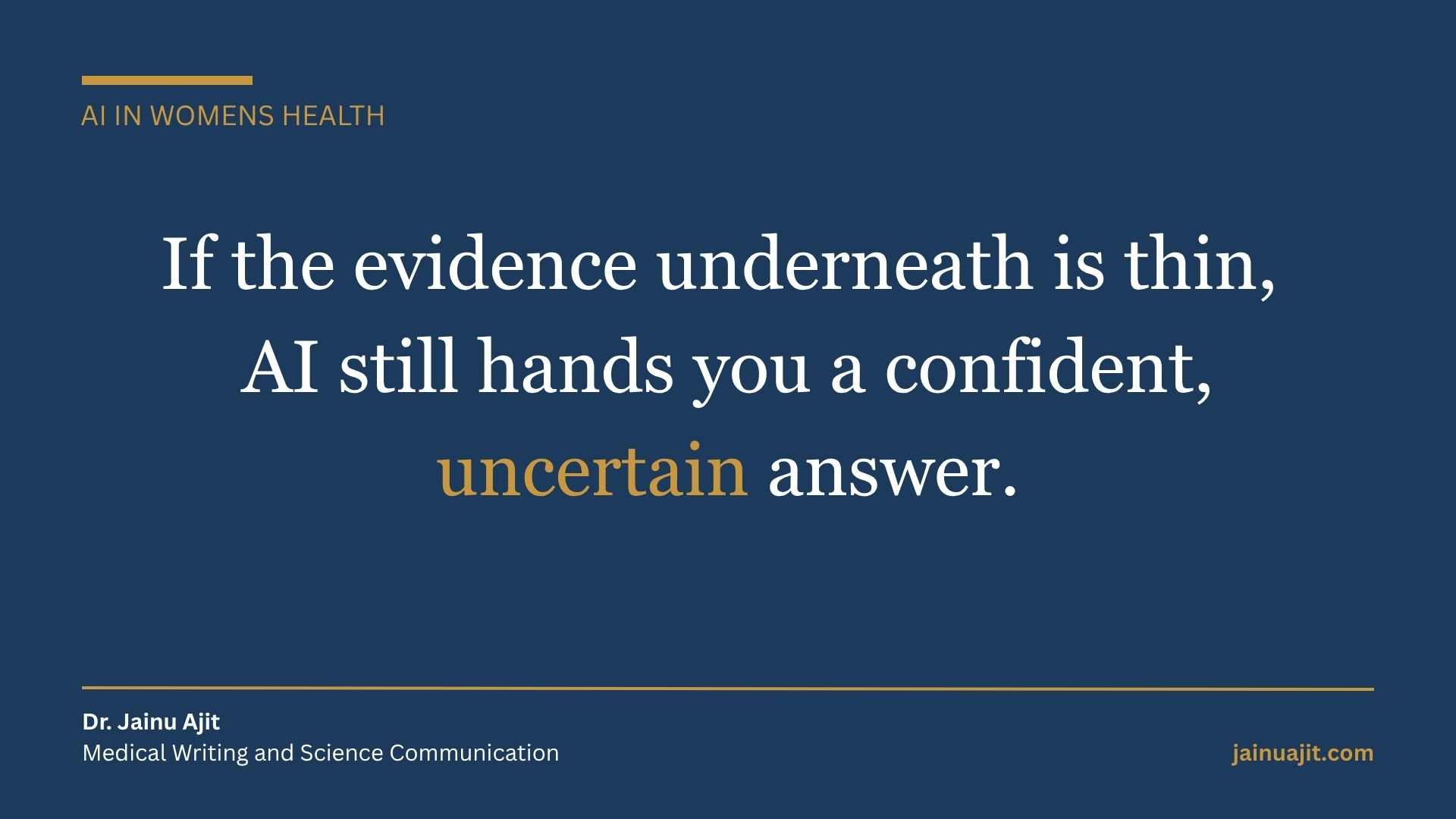
So, when an AI tool gives a personalized answer in that context, the question is not just about accuracy. But ACCURATE AGAINST WHAT? Where is the evidence? Because if the underlying evidence is incomplete, AI can still give you a very confident-looking answer - a very confident UNCERTAIN answer.
This came up in a conversation with Geri Stengel, who put it this way: trust and evidence need to advance together, not separately. I was also glad to hear this become part of the conversation at a fantastic Women’s Health AI consortium led by the team at Ema EQ.
Takeaway: AI can find patterns, organize information and support better conversations. But in women’s health especially, the harder work is making sure the evidence is strong enough to deserve the trust we place in it.