The Five Communication Jobs of a Health Metric

Your product gave users a number. Now what?
Part 2 of The Communication Layer in Health Tech: a series on the communication problems every health-tech team runs into.
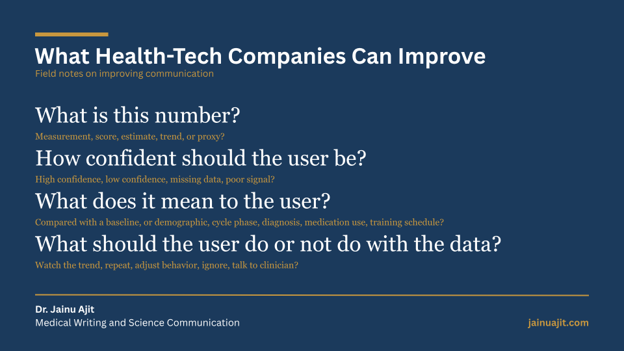
Whenever I look at a wearable, an at-home test, or a health app, I start with one question: what is this metric asking the user to do?
Surprisingly often, the answer isn’t obvious. The user is left to deduce the meaning, whether you’ve designed it or not.
That’s the communication gap this piece is about.
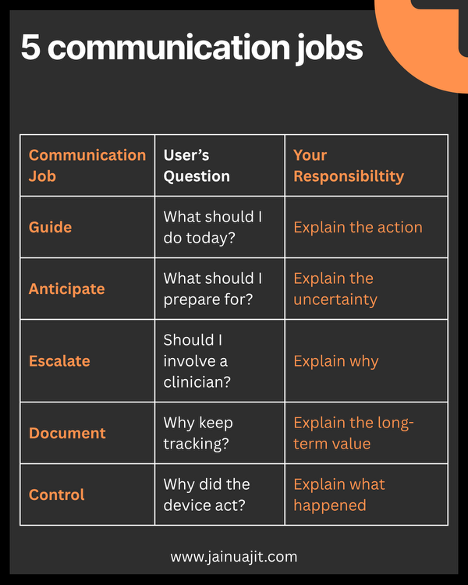
I find it useful to think about health metrics as doing one of five communication jobs.
Before we walk through them, one principle underlies all five.
Sometimes the right response is to do nothing. A single poor sleep score, or a single high resting heart rate is usually noise rather than a meaningful signal. A product that treats every change as a reason to act might unknowingly be teaching its users to be anxious.
Moving on to the 5 categories.
1. Guide
The communication question becomes: “What should the user do today?”
This is probably the most common communication job in consumer wearables today. The answer to this can be an immediate response or a delayed one. For example, a stand reminder, a hydration nudge, a stress score, a heart-rate zone, a recovery score, each points to a near-term decision: stand up, drink water, take a break, slow down, skip the heavy session.
Even if a product doesn’t directly state these actions, the user still infers them based on how they interpret colors, scores, trends, or notifications. The problem with letting a user come to their own conclusions is that it can sometimes backfire. For example, a step goal attached to “go for a walk” reads as encouragement to one person and as a source of guilt, or a trigger to overtrain, to someone else.
Good communication is directed to prevent the wrong interpretation. Remove any confusion.
Communication checklist for a guided user response
- Does the user know what action is expected of them?
- Is one reading enough to act on, or should they wait for a trend?
- Is it clear the action is optional?
- Could the wording create guilt or compulsion?
2. Anticipate
The communication question becomes: “What should the user prepare for?”
This job is slightly different from guiding a decision in the present. Here, the decision appears slightly ahead. For example, a rising migraine-risk window, a period approaching, an estimated fertile window, or a pattern suggesting the probability of an outcome. This gives users time to prepare by carrying appropriate medication, lightening the calendar, or bracing for a high-risk window.
Anticipation is powerful because preparation is one of the most useful things you can hand someone managing their health. But it comes with a nuance. The future is probabilistic, and your phrasing must carry that. A growing number of products use AI tools to provide a more personalized approach to forecast high-risk windows earlier. In this case, inform users how you arrived at the algorithm. You don’t have to give away your trade secrets, but on a higher level, explain what information the model considers and what kinds of evidence informed its development.
The whole job is communicating a likelihood as a likelihood.
Communication checklist for anticipatory user responses
- Is the uncertainty communicated, or does it read as a certainty?
- Is the user being given a probability or a promise?
- Is there enough lead time to actually prepare?
- What does the message do if nothing happens?
3. Escalate
The communication question becomes: “Should the user consult an expert?”
Sometimes a number’s real job is to route the user toward a human expert. In this case, a product is not trying to explain the data. Rather, it is trying to help the user decide whether to consult a doctor. A resting heart rate that’s been running above the user’s own normal for a couple of weeks, or an overnight metric that has drifted and stayed drifted. The messaging here is not to cause alarm (by flagging the data as THIS IS WRONG) or silence (the user who sees something is wrong but does not get any acknowledgment loses trust in the product). Instead, the messaging needs to be along the lines of “this has been unusual for you, and it may be worth a conversation.”
Here again, the messaging must be clear. What trend was observed, why it is different from the user’s baseline, and then pointing towards a professional rather than pretending to be one.
Get that right, and you’ve said the caring thing without overstepping what a product should say.
Communication checklist for escalating user responses
- Is the signal baseline-relative, or an absolute that could frighten?
- Is the urgency proportional to what the data actually shows?
- Is the next step clear without being a specific medical instruction?
- Are the limitations of the reading acknowledged?
4. Document
The communication question becomes: “Why should the user keep tracking?”
This is the slow lane, and in my view the most underrated job a number can do. Some metrics matter not for what they trigger today, but for the record they build over time.
Tracking a pattern, a cycle, a mood, or a pain level daily can help compile data for later use as evidence. This record can provide evidence of patterns that support conversations with clinicians. In any area where people are routinely disbelieved, including women’s health, chronic pain, and mental health, that record changes the conversation.
The biggest communication barrier is that the value is deferred, so the user needs a reason to keep logging even when things are normal. Your job is to make the long-term payoff legible in the short term and to help someone see the value of the record they are building.
Communication checklist for documenting data
- Does the user understand why tracking has value even when nothing changes day-to-day?
- Can they see the record accumulating, not just today’s number?
- Is it easy to export the history or bring it to a clinician?
- Is the long-term value framed without pressuring the user to log obsessively?
5. Control
The communication question becomes: “Why did the device act?”
At the far end, the number never reaches the user. It works by adjusting in real time, often while the user is asleep or simply living their day. Examples include automated insulin delivery systems, pacemakers, and auto-adjusting CPAPs. For this category, clarity is key. Communications must focus on explaining why the device acted.
Since this largely falls under medical devices subject to regulatory oversight and not wellness products, we will come back to it in another article.
Every metric has a communication job
I split health data under five categories, but they all ask the same question: what is this metric asking the user to do?
Every metric already has a communication job. The only question is whether your team has decided what that job is.
Two products can measure exactly the same physiology. The difference is that one tells people what to do with it, and the other leaves them guessing.
That’s the communication layer. And increasingly, I think it’s where health products will distinguish themselves.