What Wearable Health-Tech Companies Can Improve
The next advantage in digital health isn’t a better sensor. It is a better sentence.
A note for the people building wearables, apps, and health tools.
This piece was sparked by Anna D. Zych’s latest article in the newsletter The Science Behind Wearables, where she breaks down the variability behind how metrics are measured.
A number on a health app is two different things at once.
- To the company, it is a data point captured by a sensor, cleaned by an algorithm, and turned into an output.
- To the person reading it at 7 a.m., it is a verdict about their body.
Most of digital health has spent the last decade improving the company side of the number, improving the sensor (sometimes adding more sensors), correcting the signal, or modifying the algorithm or the model.
Far less attention has gone to the other side: whether the person reading it can actually understand what it is telling them, what it is not telling them, and how much confidence they should place in it.
That gap is where I think the next real advantage in wearable health tech will come from. It won’t be a better sensor, but a better sentence next to the number.
The sensors improved, but the explanations have not kept pace
Most companies are improving the hardware, inching closer to clinical-grade accuracy.
Take resting heart rate (RHR): a 2025 validation study found that consumer wearables varied in accuracy relative to a gold-standard ECG chest strap, though the differences for RHR were often small enough to be clinically negligible. (1)
That is good news! And the field keeps improving.
Researchers recently used facial-video PPG to estimate heart rate from smartphone camera footage. (2) The work showed accurate reporting across skin tones, thereby addressing a long-standing limitation of wrist sensors.
Ongoing research in the field shows that the market is responding to consumers’ growing needs.
Of course, that doesn’t mean all problems are solved.
For example, measuring blood oxygen levels is still catching up. A wearable estimates SpO₂ (Saturation of Peripheral Oxygen, which estimates blood oxygen levels) by comparing the amounts of red and infrared light reflected from your wrist. But the reading can be affected by factors like skin pigmentation, tattoos, sensor placement, movement, and signal quality. Skin-tone bias is already well documented in clinical pulse oximetry. (3,4)
Think about this: someone glances at a blood-oxygen reading on their wrist. Do they know that their skin tone or the tattoo under the sensor might be affecting the reading?
How clearly are companies communicating such nuances to users? Is the user looking at a measurement, an estimate, a score, a proxy, or a trend?
Each of these means something different. And yet, most devices present them with the same visual confidence, ranging from a number to a badge.
Sleep scores show the problem clearly
A sleep score is a single number that measures the overall quality and quantity of your sleep. Most wearables generate a sleep score. But that number is not a direct measurement in the way many users may assume. It is a score built from several inputs, and the formula varies by device. (5)
This is not necessarily a failure. For many people, sleep data can still be useful to track personal trends over time. But the communication matters. A sleep score that just says “78” is not really useful to the user. It must help them understand what went into that score, which parts were measured more reliably than others, which measurements are estimates, whether to compare this to yesterday or the past month, and, most importantly, what not to conclude from this number.
Validation studies have repeatedly shown that wearables can be useful for broad sleep-wake trends, but they still struggle more with detailed sleep-stage classification. (6)
This is not a reason to dismiss the technology, but it is a reason to explain it more clearly.
Health-tech communications is part of the product
As companies race to make the next best measurement and correct flaws in existing technologies, where can you truly find an edge?
The edge lies in clarity of explanations. That extra sentence matters as much as the sensor. To see why, look at why people wear these things in the first place.
Consumer wearables are wellness tools, not clinical instruments. But people don’t use them for entertainment. Rather, they use them to understand their bodies a little better. It gives them the confidence to walk into an appointment with something concrete to decide whether a symptom is worth a doctor’s time. They use them to understand recovery, stress, sleep, activity, menstrual cycles, fertility windows, or changes that feel hard to describe.
So, when a company hands its user a number (whether it is a cortisol level measurement or a fertility score), it is not just data. It is something they may use to make sense of their body. That raises the bar for communication.
What you show consumers earns their trust
Start with what you show. Two things decide whether your number deserves trust: how accurate it is and how honestly you describe it.
Accuracy in measurements is improving, as we have seen, but it was not really a part the user could see on their own. Honesty is. If your number is a measurement, say so. If your number is a score, explain how you calculated it. Tell them what not to do with a number, because it makes your product feel more responsible than your competitors’.
What consumers read earns you a connection
A trustworthy number is still just a number until the person knows what it means for them. That is the other half, and one where much of the communication layer needs to focus.
For example, a resting heart rate of 64 may be ideal for a runner or athlete but not for someone recovering from an illness. Interpretation is another layer in its own right. Which raises a question worth a piece of its own: where did that model learn what “normal” looks like, and was anyone like the consumer in that cohort? A number read against a wrong baseline can be accurate but still wrong for the consumer reading it.
Helping consumers understand what their number means earns something more than trust, it earns their connection. It signals that you understand them as individuals and not as part of a population.
The opportunity for health-tech teams
So, here is what I would tell anyone building in this space, from someone who sits at the interface of science and the way it gets said. The highest return on investment you can make is not by adding another sensor to measure another biomarker. It may be by improving the language around the numbers they already show.
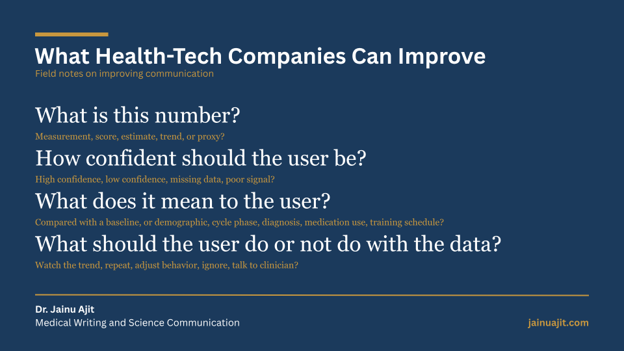
Tell people what kind of number they are looking at. Is it a measurement, a reference, or a prediction? Is it a score? If so, show consumers how it’s calculated. Flag a low-confidence metric and be more explicit about the data that the model was trained on. Give users context, explain uncertainty, and acknowledge limitations.
This is where better communication becomes a competitive advantage.
If your team is shipping numbers your users can’t read, that’s a fixable problem. My DMs are open.
References
- Dial MB, Hollander ME, Vatne EA, Emerson AM, Edwards NA, Hagen JA. Validation of nocturnal resting heart rate and heart rate variability in consumer wearables. Physiol Rep. 2025;13(16):e70527.
- Liao, S. et al. Passive heart-rate monitoring during smartphone use in everyday life. Nature (2026).
- Sjoding MW, et al. Racial Bias in Pulse Oximetry Measurement. N Engl J Med. 2020;383(25):2477-2478.
- Fawzy A, et al. Racial and Ethnic Discrepancy in Pulse Oximetry and Delayed Identification of Treatment Eligibility Among Patients With COVID-19. JAMA Intern Med. 2022;182(7):730-738.
- Sleep score details: Oura ring, Garmin, Apple Watch.
- Miller DJ, Sargent C, Roach GD. A Validation of Six Wearable Devices for Estimating Sleep, Heart Rate and Heart Rate Variability in Healthy Adults. Sensors (Basel). 2022 Aug 22;22(16):6317.