What to do with a health metric
I recently read a case report of a man whose smartwatch flagged an abnormal heart rhythm. So he went in to get it checked. His doctors found the rhythm problem, but incidentally also found lung cancer.
It is a remarkable story, right?
But it does not mean a smartwatch can detect lung cancer.
The watch flagged an arrhythmia, and the cancer was discovered during the workup that followed. This was a case report that was published because it was unusual (this does not happen often).
What it does show is that his watch noticed something unusual, and he acted on it. It also shows that he had access to the specialists, testing, and follow-up care needed to treat what they found.
Someone with money can investigate every odd result they see, while others have to choose the ones that are worth the trouble. (Flashback to my days as a student, when I would debate whether it was worth paying a $35 consultation fee for an appointment two weeks away. By then, the fever would probably be gone anyway.) Take another recent example: Bryan Johnson. He had access to extensive testing and a medical team helping him interpret his results. Most people don’t have that kind of money. They probably have a watch, a number they do not fully understand, and a decision about whether an abnormal reading is worth the cost of finding out.
Cost matters. So do resources like devices, subscriptions, insurance coverage, lab tests, and follow-up appointments. All these affect whether someone can act on their health data. And all of this needs to become more affordable and accessible.
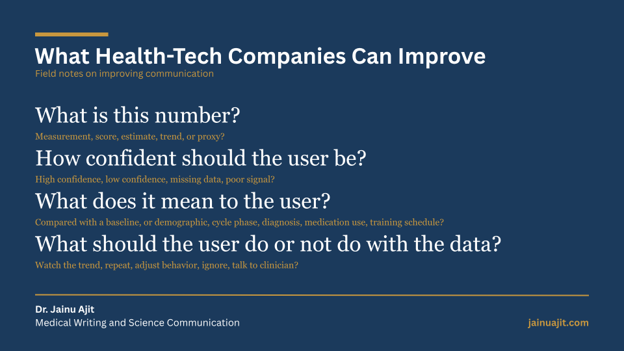
There is another kind of access here: access to understanding. Because collecting a health metric is not the same as making health information accessible. People should be able to find out what their wearable actually measures, where the number came from, what the evidence says about it, what it cannot tell them, and whether they are supposed to do anything about it.
None of this is about replacing healthcare. A smartwatch is not going to tell you if you have cancer, and nobody should sell it that way.
It is about having enough context to know when a number may be worth taking seriously and what an appropriate next step might be. Companies have a responsibility to help provide that context.
This is the gap I think science communication should be filling in health tech.
A research paper can explain why a metric matters, or whether a new sensor solves a limitation that previous technologies could not. A patient story can show what it looks like in real life. And careful writing can connect these two things without turning an association into a diagnosis.
Which is why I think the value of a wearable lies in answering the question that comes right after the number appears: What am I supposed to do with this?
source: Cole APC, Kar A, Nimako K, Smelt J. Smartwatch helps detects lung cancer: Using personal technology to advance healthcare. JRSM Open. 2022;13(1):20542704211068651. For teams building these products