Yeztugo: A Twice-Yearly PrEP Injection Transforming HIV Prevention
Summary
This article summarizes the June 2025 FDA approval of Yeztugo, a long-acting HIV prevention drug for adults and adolescents. The piece reviews Yeztugo’s mechanism of action, clinical trial data, and potential impacts on HIV prevention.
Background
Understanding HIV and AIDS
Human Immunodeficiency Virus (HIV) is primarily transmitted through bodily fluids including blood, semen, vaginal fluids, and breast milk. It originated from a simian immunodeficiency virus (SIV) affecting chimpanzees, spreading to humans through cross-species transmission via contaminated blood exposure.
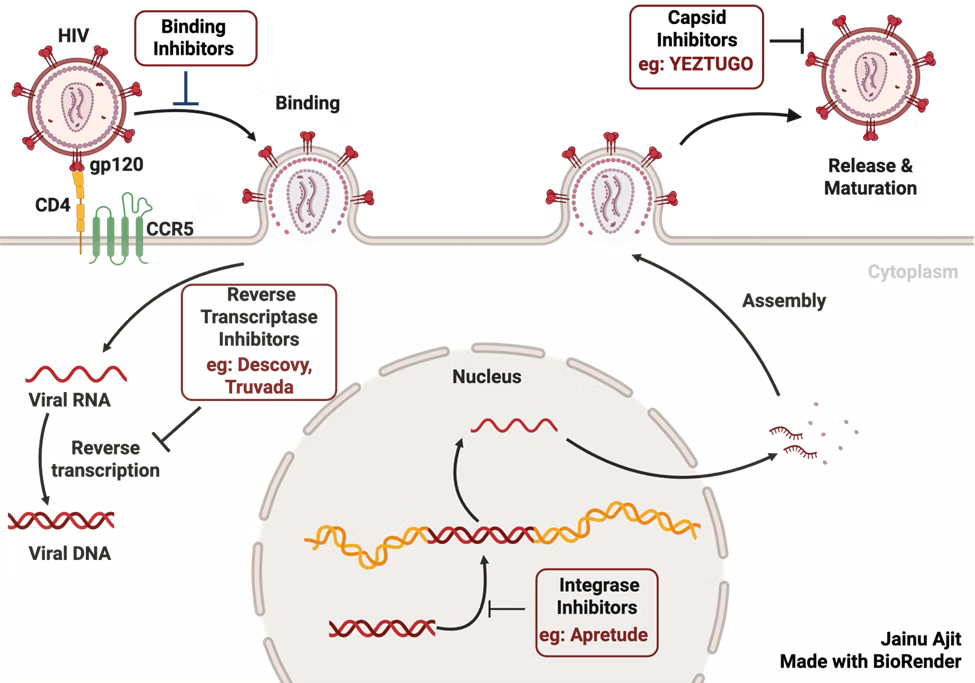
HIV targets CD4+ T cells critical for fighting infections. The viral glycoprotein gp120 binds to CD4 receptors on these cells. Once infected, reverse transcriptase converts viral RNA to DNA, which integrates into the host cell to produce multiple copies. Over time, CD4+ T cell counts decline, increasing infection susceptibility and potentially leading to AIDS if untreated.
Prognosis Without Treatment
Without treatment, HIV-positive individuals have an average lifespan of approximately 11 years. With an AIDS diagnosis, this decreases to roughly three years without medical intervention.
Strategies to Prevent Viral Replication
Understanding HIV infection mechanisms enables development of preventive strategies:
- Binding/Infection: gp120 inhibitors block HIV from binding to CD4 receptors. Chemokine receptor inhibitors targeting CCR5 and CXCR4 coreceptors also prevent viral binding.
- Reverse Transcription: Reverse transcriptase inhibitors prevent conversion of viral RNA to DNA, inhibiting viral replication.
- Integration: Integrase inhibitors, particularly integrase strand transfer inhibitors (INSTIs), block viral DNA integration into host DNA.
- Replication and Reinfection: Multiple mechanisms can be targeted:
- Protease inhibition: HIV protease inhibitors prevent cleavage of precursor proteins necessary for assembling new viral particles.
- Capsid inhibition: Capsid inhibitors prevent formation of protein shells protecting viral genetic material, stopping viral replication and subsequent infection.
Current Treatment Options
The standard HIV treatment is antiretroviral therapy (ART), combining drugs targeting different viral infection and replication stages. This combination approach effectively controls viral levels while minimizing drug resistance, allowing patients to maintain higher CD4+ T cell counts and live longer, healthier lives.
Limitations of ART
Despite effectiveness, ART requires daily lifelong administration. Discontinuation causes viral rebound and disease progression. Side effects including nausea, diarrhea, and mood changes, combined with social stigma, contribute to poor adherence, limiting this approach’s effectiveness.
Lenacapavir: A New Approach
Lenacapavir received FDA approval as Sunlenca by Gilead in 2022. As a capsid inhibitor, it prevents HIV from forming mature virus particles. Initially approved for use with other antiretrovirals in multidrug-resistant HIV cases, its remarkable six-month half-life enables less frequent dosing, improving patient compliance.
Yeztugo
Yeztugo contains lenacapavir as its active ingredient. Approved in June 2025 for pre-exposure prophylaxis (PrEP) in HIV-negative high-risk individuals, Yeztugo reduces HIV acquisition in high-risk adults and adolescents. Its distinguishing feature is long-lasting effects requiring only biannual or twice-yearly administration.
Comparison to Existing PrEPs
PrEP medications reduce HIV contraction risk in high-risk adults by 99% when taken as prescribed.
Current PrEP options include daily oral tablets Truvada® and Descovy®, both inhibiting reverse transcriptase-mediated viral replication. Apretude®, a once-monthly injectable Integrase Strand Transfer Inhibitor (INSTI), offers longer-acting alternatives. Yeztugo requires only two injections annually. However, unlike self-administered oral PrEP, Yeztugo requires healthcare provider administration.
| PrEP | Frequency of Dosing | Mode of Delivery | Side Effects | Cost per year |
|---|---|---|---|---|
| Truvada® | Daily | Oral | nausea, diarrhea, headache, fatigue | $24,000 |
| Descovy® | Daily | Oral | nausea, diarrhea, headache, fatigue | $26,400 |
| Apretude® | Monthly | Injectable intramuscular | nausea, diarrhea, headache, fatigue, injection site reactions | $22,200/year |
| Yeztugo | Bi-Annual | Injectable subcutaneous | Injection site nodule | $28,218/year |
Clinical Trial Outcomes
Yeztugo underwent evaluation in two randomized, double-blind, active-controlled clinical trials. The first trial enrolled predominantly young cisgender Black female participants, demonstrating 100% efficacy. The second trial included a broader diverse cohort of cisgender men, transgender women, transgender men, and gender nonbinary individuals, showing 89% HIV infection risk reduction compared to daily Truvada recipients.
Side Effects
63% of participants reported injection site nodules based on clinical trials leading to FDA approval.
Cost
Yeztugo costs $14,109 per injection or $28,218 annually in the United States. Annual Yeztugo costs compare favorably to existing PrEP options, with twice-yearly injection convenience potentially improving compliance.
Conclusion
Yeztugo represents a significant HIV prevention advancement through its long-lasting formulation and high effectiveness. Its approval signals movement toward simpler, higher-adherence PrEP options benefiting high-risk populations. Ensuring equitable community access will further enhance effectiveness.
Updates
Newer findings and follow-ups on this piece, added as they come up.
Lenacapavir, the active ingredient of Yeztugo, works by causing the viral capsid to rupture. A new paper looks at how this happens at the molecular level.
→