Insulin sensitivity can vary according to menstrual cycle
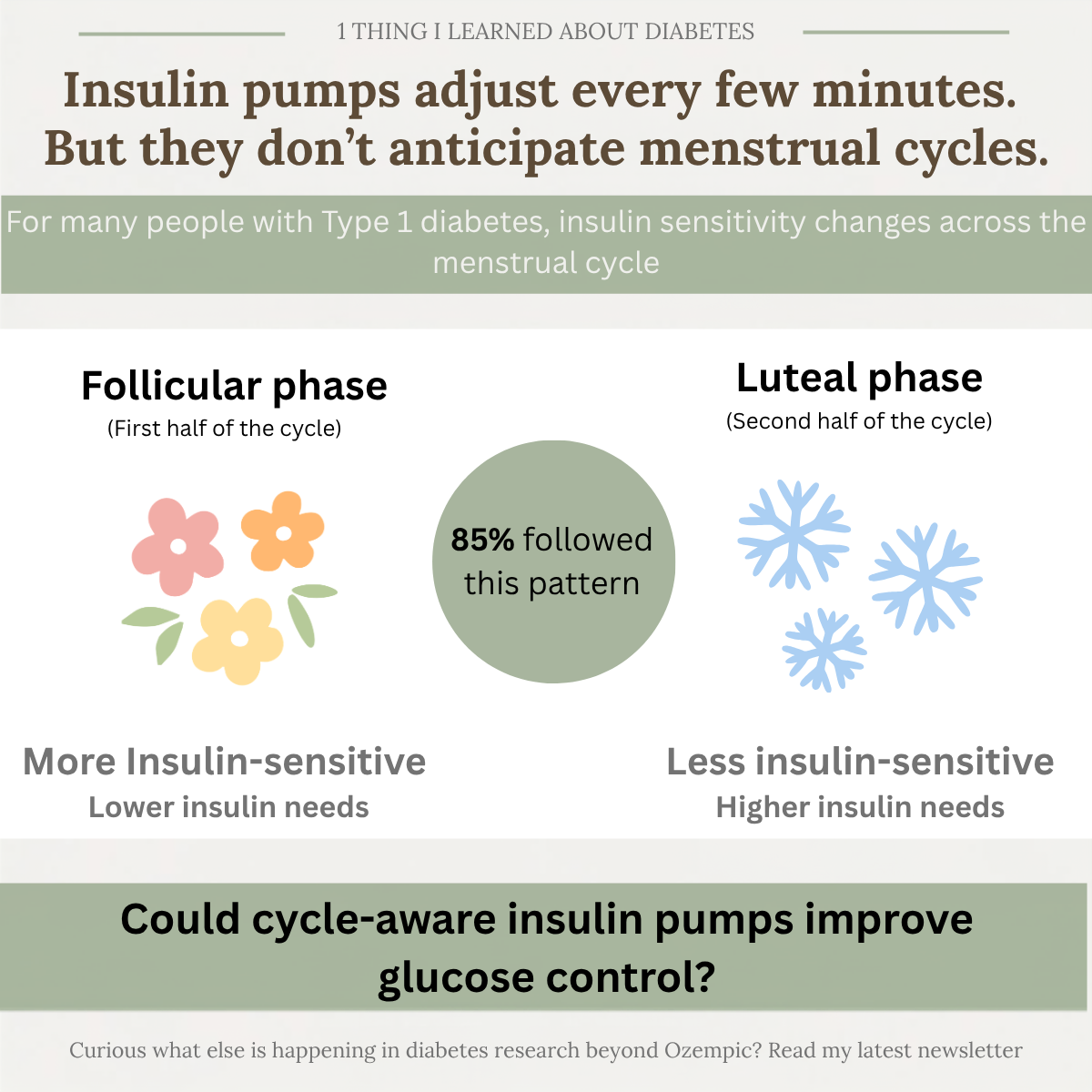
I went looking for what’s new in diabetes research. But I DID NOT expect to end up reading about menstrual cycles.
Here is what puzzled me. An insulin pump can adjust itself every few minutes. But it still cannot anticipate one thing- menstrual cycles. So, are insulin pumps due for an update?
YES, according to a new study published in Diabetes Care. Researchers examined whether menstrual cycles influence insulin sensitivity (a measure of how well cells respond to insulin) in individuals with Type 1 diabetes. The data came from 380 cycles from 77 participants.
Results:
- Insulin needs and glucose were higher in the luteal phase (the second half of the menstrual cycle)
- About 85% of participants followed this general pattern – higher insulin sensitivity in the follicular phase and lower insulin sensitivity in the luteal phase.
- There were also variations across individuals.
This is not the first study to report a cycle-related pattern. A 2023 Apple Health Women’s Study showed similar results after analyzing around 2000 menstrual cycles from over 200 individuals; this time, however, the focus was not on Type 1 diabetes.
So why is this important? For menstruating individuals using automated insulin delivery systems, the lack of cycle-based methods makes it challenging to maintain glycemic control across a month.
The study has several limitations. Exercise, illness, sleep, stress, and even population differences are factors that influence insulin sensitivity but were not controlled in this study.
But this sounded like an easy-ish fix to me because we already collect a lot of these data. What we need is a way to connect these dots along with (yes, you guessed it) a lot of money. To me, that sounds like a digital-health problem worth investing in.
Sources 1)Hossmann S. et al., Effects of Menstrual Cycle on Insulin Sensitivity in Type 1 Diabetes: An Observational Study of Individuals Using an Automated Insulin Delivery System. Diabetes Care 20 August 2026; 49 (9): 1673–1680. https://lnkd.in/dJmCMTpu
2)Apple Women’s Health Study 2023 - https://lnkd.in/dYGE5dFf